
There is a strange moment in the AEC sales cycle that nobody talks about enough.
The RFP has not been released.
There is no proposal to write. No interview to prepare for. No shortlist has officially been announced.
And yet, somewhere inside a developer’s office, a municipality, an institutional client, a general contractor or a project team, opinions are already being formed about who belongs in the room.
Someone mentions a firm they worked with three years ago.
Someone else recognizes the principal from LinkedIn.
A project manager remembers seeing a strong case study. A developer searches the firm and spends ten minutes on its website. Another person asks an AI platform which architecture, engineering or construction firms have experience with this particular type of project.
By the time the RFP drops, the invisible shortlist may already exist.
That changes the role of brand strategy for AEC firms.
Brand cannot simply be the thing the marketing team worries about after the business has decided what it wants to pursue. It is part of how the market understands your expertise before a formal buying process begins.
Because you cannot win an RFP if the client learns your name on page one of your proposal.
For Vancouver AEC firms in particular, that matters. The market includes established local practices, national firms, specialized boutiques, contractors, consultants, developers, manufacturers and multidisciplinary teams competing across increasingly sophisticated project requirements.
At the same time, the work itself is changing. Vancouver continues to move toward lower-carbon buildings, with the City targeting zero emissions from new buildings by 2030 and a 40% reduction in embodied emissions from new buildings and construction projects compared with 2018. Provincial construction conditions are changing too. BuildForce Canada’s 2026 outlook forecasts B.C. non-residential investment rising to a historic peak in 2027 before declining as several major projects conclude.
This is not an industry where standing still is much of a strategy.
The firms that become known before the next opportunity arrives have an advantage.
The short version (summary): What makes a strong AEC brand?
A strong AEC brand gives clients a clear answer to five questions:
Who are you for?
What are you exceptionally good at?
Why does that matter to your clients?
Why should they believe you?
What will they remember after they leave the room?
Everything else, from visual identity and content marketing to proposals, websites, social media, SEO and business development, should reinforce those answers.
That is what AEC branding is really about.
Not looking polished for the sake of looking polished.
Being understood.
And remembered.
Table of Contents
What Is AEC Branding… Really?
AEC stands for architecture, engineering and construction, but AEC branding covers a much wider ecosystem.
Architects. Interior designers. Engineers. General contractors. Developers. Manufacturers. Suppliers. Consultants. Project managers. Specialists. And all of the people whose expertise contributes to the built world.
AEC branding is the deliberate process of shaping what those clients, collaborators, employees and decision-makers understand and remember about a firm.
There are three connected pieces.
Brand strategy
Your brand strategy defines what the firm stands for, which target audience matters most, where it competes, what it wants to become known for and why a client should choose it instead of another credible option.
Brand identity
Brand identity is how that strategy is visually expressed.
It includes the logo, typography, colour, photography, layouts, graphics, proposal templates, presentations, site signage and other visual assets people commonly think of when they hear the word “branding.”
Brand experience
Brand experience is what happens when somebody actually encounters you.
Your website.
A project story.
An RFQ response.
An interview presentation.
A conversation with a principal.
A job-site meeting.
A LinkedIn post.
A conference presentation.
A proposal.
A Google search.
Increasingly, even an AI-generated answer.
Those experiences either reinforce the brand strategy or slowly undermine it.
That is why a new logo will rarely fix a positioning problem.
You can put a beautiful identity around a firm that nobody understands.
It will simply make the confusion look nicer.
The Invisible Shortlist: AEC Business Development Starts Before the RFP

The traditional version of AEC business development often looks something like this:
Relationship.
Opportunity.
RFQ.
Shortlist.
RFP.
Interview.
Win.
The real journey is messier.
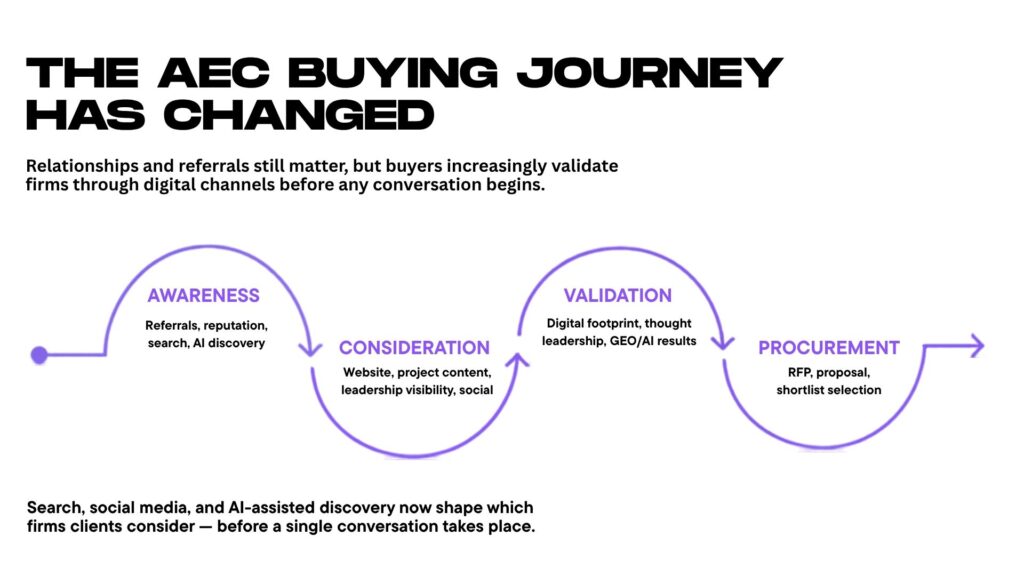
A referral can trigger awareness. Awareness triggers validation. A buyer looks at the website. They examine past projects. They search the principals. They ask colleagues. They see who is publishing useful thinking. They check whether the firm’s claimed specialization actually appears anywhere in its work.
Then they form an opinion.
Only later does procurement formalize the process.
Research into professional-services buying has been pointing in this direction for years. Hinge’s research into AEC buyers specifically examines how buyers find alternatives, select firms and evaluate brands, while current SMPS research is looking directly at how AEC buying behaviour and procurement methods are changing.
This is the Invisible Shortlist.
It is the mental list of credible firms that exists before the official shortlist does.
And it explains why brand awareness matters so much in professional services.
LinkedIn’s B2B Institute popularized the 95-5 rule: at any given time, roughly 5% of potential B2B buyers may be actively in-market while the remaining 95% are future buyers. The exact ratio will vary depending on category and buying cycle, but the strategic lesson matters. Marketing cannot only show up when somebody happens to be buying.
For AEC firms with long, infrequent and relationship-heavy buying cycles, that idea becomes even more relevant.
You cannot perfectly time familiarity.
You build it.
Here’s what Alexa Bustamante, principal; would would say about AEC branding. Note: we she’s provided detailed verbatim about AEC branding throughout the article:
The “3% of the market is ready to buy right now” statistic is generally attributed to Chet Holmes and his sales and marketing framework called the Buyer’s Pyramid, presented in his 2007 book, The Ultimate Sales Machine. His organization still teaches the framework today through Chet Holmes International.
Holmes’s original Buyer’s Pyramid is:
- 3% are buying now
- 7% are open to buying
- 30% are not thinking about it
- 30% think they’re not interested
- 30% are definitely not interested
The reason this is critical is that if you are constantly trying to time the market with your content, and you only post the results of your project rather than the before, during, and after, then what are the chances that the prospect whose pursuit you’re trying to win happens to be ready to buy at the exact moment you post the results of your project and the completed photos?
You need to be posting consistently at every stage of the project because it’s impossible to time the market. The goal is to capture prospects at different stages of the buyer’s journey and ensure your content is seen at the right time.
Why AEC Branding Matters More Than Most Firms Realize
AEC brands operate under an unusual combination of conditions.just an idea, can you pump a view other articles of mine from this tab: https://spacesuncovered.com/insights/
And have it copied the brand tone/voice? It doesn’t really match other pieces that I’ve written.
The projects are expensive.
The consequences of choosing poorly can be serious.
Multiple stakeholders are involved.
Buying cycles can stretch over months or years.
Qualifications matter.
Relationships matter.
Experience matters.
Past work matters.
And, frustratingly, many highly capable firms sound almost exactly the same.
Reputation does a lot of the selling
The built world has always been relationship-driven.
That is not disappearing.
But a referral is increasingly the beginning of validation, not the end of it.
A prospective client who hears your firm’s name can investigate you within minutes.
They can see what projects you feature, whether your leadership is visible, what expertise you publish, how current your digital presence feels and whether your supposed specialization is reflected in your work.
Referrals still matter enormously.
The digital layer determines what happens next.
People are part of the product
AEC is professional services.
Clients are not only buying a building, drawing package, engineering solution, construction process or technical specification.
They are buying confidence in a team.
They want to know who will solve the problem when a design constraint appears.
Who understands the jurisdiction.
Who can explain the risk.
Who has seen something like this before.
Who can bring the consultant team together.
Who they trust when the project gets complicated.
That makes the visibility of individual experts extraordinarily valuable.
We follow people.
Not logos.
Your past work affects your future work
A portfolio is therefore more than a gallery.
It is evidence.
The problem is that many AEC brands stop at the evidence that is easiest to photograph.
Project name.
Location.
Sector.
A few beautiful images.
Finished.
But the finished image rarely tells us why the project was difficult, what the team contributed or what made the solution intelligent.
Great work deserves more than a caption.
What Makes AEC Branding in Vancouver Different?
A brand strategy built for an AEC firm in Vancouver should understand Vancouver.
That sounds painfully obvious.
It is also surprisingly easy to miss.
Dropping the word “Vancouver” into an SEO title while publishing the same generic positioning used everywhere else is not local strategy.
The local market has its own conditions.
Competition comes from several directions
A Vancouver practice may be competing against a firm down the street, a national company with a local office, a highly specialized boutique, a multidisciplinary consultancy or an international name brought in because of a particular project type.
That means “we are experienced” is not differentiation.
Everybody on a serious shortlist is experienced.
The useful question is:
Experienced at what, for whom, under which conditions, and in a way that creates what advantage?
That is where positioning starts getting interesting.
Sustainability cannot be a vague brand adjective
“Sustainable” is one of those words that has been used so often it can become almost meaningless.
In Vancouver, the underlying issue is anything but vague.
The City continues to regulate operational emissions and embodied carbon through building policy and the Vancouver Building By-law. Its current policies include specific requirements for energy performance and embodied-carbon reporting.
So if sustainability is central to an AEC brand, prove it.
Show the methodology.
Show the people doing the work.
Explain an actual tradeoff.
Describe the material decision.
Talk about the energy model.
Document what changed.
The stronger story is rarely, “We care about sustainability.”
It is, “Here is the decision we made, why we made it and what changed because of it.”
Talent is part of the brand battle too
Clients are not the only audience evaluating AEC brands.
So are architects, engineers, designers, project managers, estimators, superintendents and technical specialists.
In British Columbia, professional credibility has very real dimensions. For example, the practice and title of architect are regulated, and an Architect AIBC must meet professional requirements established in the province.
Credentials matter.
So does everything around them.
What kind of work will I do?
Who will I learn from?
Does leadership have a point of view?
Are interesting people doing interesting work here?
Will I have a voice?
Employer brands and corporate brands cannot live on separate planets.
The Sea of Sameness Is an AEC Marketing Problem
Open five AEC websites.
Remove the logos.
Now read the first paragraph of each.
How many could be swapped without anyone noticing?
Innovative.
Collaborative.
Integrated.
Passionate.
Award-winning.
Client-focused.
Sustainable.
Committed to excellence.
None of those things are inherently bad.
They are simply weak differentiators because almost every credible firm would happily claim them.
This is one of the central problems in AEC marketing.
The firm wants to sound credible, so it reaches for the language its category has already established as credible.
Then everyone sounds alike.
The result is a sea of sameness.
Standing out does not mean inventing a quirky personality your organisation cannot sustain. It means uncovering the things that are genuinely distinctive about the work, people, process and perspective.
Ask:
What do clients repeatedly hire us to solve?
Which projects make our team unusually valuable?
Where do we have depth others do not?
What do our best clients say about us when we are not in the room?
What do we understand because of the work we have actually done?
What can we credibly say that our five closest competitors cannot say just as easily?
That last question tends to make branding workshops much more interesting.
Here’s what Alexa, thinks about the topic:
I worked with a company where, when we kicked things off at the start of our engagement in the UNCOVER phase, they thought prospects believed they were too expensive, and that was why they weren’t winning jobs. As it turns out, prospects felt that once they worked with them, they actually weren’t that expensive because the company offered a lot of value, more than their competitors.
But because that value wasn’t packaged, positioned, and presented up front, their fees were deemed the highest. However, once end users experienced working with their competitors, they realized they ended up spending a lot more through change orders with those competing companies than they would have if they had gone with the initially higher fee.
That was because this company actually included a lot of services that they didn’t promote or make end users aware of during the “pitch” stage. This research and insight were revealed during Spaces Uncovered’s market perception survey, where feedback was collected from existing and past customers. This led to building out a strategy to help showcase and market the value that this company already brought to its clients, while finding a better way to package it and display that value before the decision-making phase of procurement. Marketing the value earlier in the buying cycle was important because it gave more context around their fee structure, which would then help change the prospect’s perception of spend.
The Foundations of an Effective AEC Brand Strategy
Strong AEC brands are built from the business outward.
Not from the logo inward.
1. Decide who you actually want to matter to
“We work with everyone” sounds flexible.
Strategically, it can be expensive.
Your highest-value opportunities might come from municipalities, developers, institutions, industrial companies, healthcare organisations, universities, general contractors or a very specific project category.
Different audiences look for different proof.
A municipal buyer may care about public accountability, comparable project experience and stakeholder complexity.
A developer may prioritize marketability, certainty, schedule and commercial outcomes.
A general contractor evaluating an engineering partner may care about responsiveness, coordination and whether the team can solve a problem without turning every issue into a three-week exercise.
Your target audience shapes the story.
AEC firms do not necessarily need to refuse every opportunity outside their positioning. But the market should understand where they are strongest.
Being available to everybody does not require being positioned for everybody.
2. Understand how clients actually choose
Do not build a marketing plan entirely from assumptions inside the company.
Talk to clients.
Talk to former clients.
Talk to collaborators.
Talk to employees.
Talk to a prospect you did not win, if they will speak with you.
Ask what originally put the firm on their radar.
Ask what made them trust you.
Ask what almost stopped them.
Ask which alternatives they considered.
Ask how they would describe you to somebody else.
This is where brand research becomes business intelligence.
Here’s a what Alexa has to say about this:
I can speak to my market perception survey, which is conducted during the UNCOVER phase. During this phase, Spaces Uncovered creates a survey that is white-labeled and written on behalf of the company, aka the client. This survey is meant to gain insights from the client’s existing and past customers to understand how those customers perceive the brand. One thing is how a company perceives its own brand and what it feels its strengths and weaknesses are. Another thing is understanding how its past clients and customers actually perceive it.
That gap is the gap that Spaces Uncovered is here to solve and ensure that we position the company appropriately in the market. As an example, with one client, the market perception survey results came back and the findings were that customers felt the company had a very dated approach and dated brand materials. Although they had a very modern way of actually doing business, their website, social media, RFP documents, pitch decks, and brochures did not align with this modern way of doing business.
It made them look more antiquated than they truly were. The unanimous feedback was that time and money needed to be invested into elevating the brand collateral to, in turn, elevate the look and feel of the brand.
3. Find a differentiator you can defend
A claim becomes powerful when there is proof behind it.
“We understand complex healthcare environments” becomes more useful when followed by a body of relevant projects, specialist leaders, regulatory knowledge and stories showing how that expertise affected decisions.
“We are collaborative” is weak.
Showing how a contractor, architect, manufacturer and consultant jointly solved a constructability problem tells us something.
This is where brand story development meets positioning.
4. Build a positioning system
One useful structure is:
Who we serve → What we specialize in → What problem we solve → How our approach differs → Why you should believe us
The point is not to turn that structure into stiff website copy.
It is a strategic planning tool.
Once the positioning is clear, the messaging gets easier.
So does content creation.
So does business development.
So does SEO.
Clarity compounds.
Build a Messaging Hierarchy, Not a Bag of Taglines
Good positioning needs a structure beneath it.
A useful messaging hierarchy might include:
- The central positioning idea
- A clear value proposition
- Three or four strategic brand pillars
- Supporting proof for each pillar
- Priority messages for specific audiences
- A natural elevator pitch
- A defined brand voice
Then it needs to show up everywhere people experience the firm.
- Website.
- Project sheets.
- Qualifications packages.
- RFQs.
- Presentations.
- Recruitment.
- Email marketing.
- LinkedIn.
- Conference introductions.
- Sales conversations.
If the website says one thing, the proposal another and the principals something completely different, that is not flexibility.
That is brand fragmentation.
Here is an example of it from Alexa:
This first example is for an HVAC supplier and distributor. This was their initial value proposition line displayed on their website: “Hudson Sales represents manufacturers in HVAC, evaporative cooling, refrigeration, filtration, hydronics, VRF, and vibration isolation in the mechanical construction industry.” Once we completed Spaces Uncovered’s market perception survey for this client, we discovered that their past customers didn’t understand the value of the problem they were solving. As a result, customers made decisions based on the bottom line because that was how the company’s main differentiation came across. They were also perceived as a supplier heavily anchored to a few specific manufacturers, which made them appear to have a limited breadth of offerings compared to competitors. With that limitation in mind, the market did not understand a clear reason to go to them, what main problem they were trying to solve, or who they were solving it for. That’s why we worked with this client to develop new positioning lines for each of their two main target audiences:
- Construction managers, aka owners’ reps and landlords of buildings
- Mechanical contractors, who they work with on the technical specification of the mechanical unit
The problems these two target audiences face are very different. Thus, the sales positioning line should vary to reflect the pain points of each specific audience. We developed a brand guidelines document that helps educate the team and sales reps on how to vary their messaging and sales points depending on which audience they are meeting with. Here is one page from their guidelines.
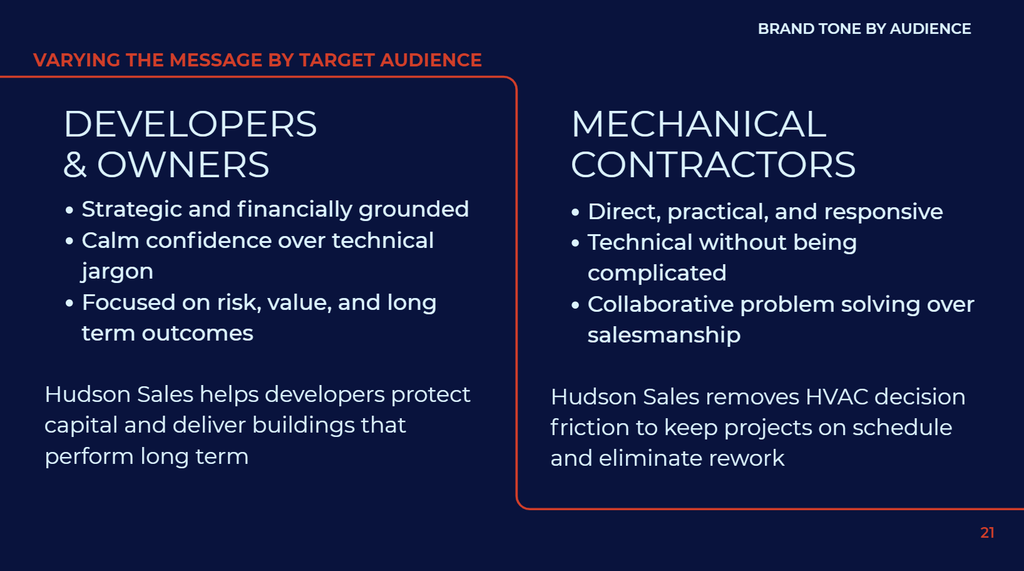
We landed on a different value proposition for each audience, which was then displayed on the website, and we created two different pitch decks. Each pitch deck had different photography, messaging, and solutions that reflected what was important to each of the two target audiences and ideal customer profiles.
We then reflected this on their website by creating two different tabs, one for each ideal customer profile, under the “Who We Serve” section.
Your Portfolio Is Proof. It Is Not Your Brand.
A beautiful portfolio proves you have produced beautiful work.
Useful.
But incomplete.
The stronger question is what the work reveals about your thinking.
This is where project storytelling becomes one of the most underused AEC marketing strategies.
Instead of:
Project name
Location
Completion date
Four photographs
Try uncovering the project narrative.
What was happening before the work started?
What problem was the client actually trying to solve?
Why was it difficult?
What constraint changed the design?
Where did the team disagree?
What technical problem required an unusual solution?
Who else contributed?
What almost went wrong?
What decision had the largest downstream impact?
What would nobody know from looking at the finished photograph?
That is the story.
At Spaces Uncovered, one storytelling framework for extracting it is BUILD:
B: Background
What was happening? What was the context?
U: Urgency
What problem had to be solved? What was at stake?
I: Intention
What was the team trying to create or change?
L: Labor
What did the work actually require behind the scenes?
D: Difference
What changed because the project existed?
That is not about dressing a normal project description in dramatic language.
It is about giving the work the depth it already has.
The finished photograph is only half the story
This matters particularly for storytelling in architecture.
Architecture is easy to photograph and difficult to explain.
The photograph shows what exists.
The story reveals why.
That opens an enormous opportunity for visual storytelling, written storytelling, video storytelling and, where the project genuinely calls for it, more cinematic storytelling.
A ten-second drone clip is not automatically a story.
Neither is a beautifully edited Reel.
Storytelling best practices begin with meaning.
What should the audience understand at the end that they did not understand at the beginning?
That question applies to content storytelling, storytelling in B2B marketing and every other label we attach to the work.
Start there.
Storytelling Frameworks Should Reveal the Work, Not Manufacture Drama
There is a temptation in marketing to turn every project into an epic.
Please don’t.
The industry has enough theatre.
A useful narrative strategy helps people understand what happened and why it mattered.
Sometimes the most compelling project story is incredibly practical.
A detail that eliminated an installation problem.
A design change that made a space easier to maintain.
A product choice that solved a specification issue.
A conversation that changed the brief.
A coordination process that saved weeks.
Good brand storytelling does not make ordinary work sound extraordinary.
It uncovers the extraordinary thinking hidden inside work people have stopped noticing.
That is also the answer to how to build a narrative.
Find the tension.
Find the decision.
Find the people.
Find the consequence.
Then tell the truth well.
That is story driven marketing worth doing.
Your Experts May Be More Valuable Than Your Corporate Account

One of the biggest missed opportunities in AEC brands is hiding the people who know the most.
The technical expert stays invisible.
The principal posts twice a year.
The project leader has fifteen years of experience but no public point of view.
Meanwhile the company account publishes:
“We are thrilled to announce…”
Again.
There is nothing inherently wrong with corporate communication.
But people follow people.
A visible principal who consistently explains the thinking behind the work can create familiarity long before a buyer needs the firm.
So can an engineer explaining a technical shift.
A superintendent discussing a difficult site condition.
A designer walking through one decision.
A manufacturer explaining what specifiers misunderstand about a product.
That is thought leadership when it is useful.
Not “having thoughts.”
Sharing expertise that helps somebody see the industry differently.
This can become a connected content system:
An expert conversation becomes a long-form article.
The article becomes several LinkedIn posts.
One concept becomes a short video.
A useful discussion becomes a podcast episode.
A technical topic becomes one of the firm’s webinars.
A client question becomes an email.
The video becomes part of a project page.
The project page becomes proof in the next proposal.
One useful idea can travel.
That is a content engine.
A system, not a scramble.
E-E-A-T Matters Because Expertise Should Be Visible
Google’s E-E-A-T framework refers to experience, expertise, authoritativeness and trustworthiness.
Google is clear that E-E-A-T is not itself a single ranking factor, but its systems use signals that can help identify content demonstrating those qualities. Google also specifically emphasizes firsthand experience as an important dimension of useful content.
For the AEC industry, this makes intuitive sense even if Google disappeared tomorrow.
Who would you trust more?
An anonymous 600-word article called “Five Trends Shaping Sustainable Construction”?
Or an article written by the engineer who spent the past three years solving the issue the article discusses?
AEC firms are sitting on extraordinary amounts of expertise.
The problem is that much of it never leaves the heads of the people doing the work:
- Make authorship visible.
- Show the author’s name.
- Role.
- Credentials.
- Experience.
- Specialization.
- Professional profile.
When appropriate, have technical material reviewed by the qualified person responsible for that subject.
And give those experts something worth saying.
Here is an example from Alexa:
We have been working with Mirage Floors to help create brand awareness for their brand in BC. Mirage is a hardwood flooring manufacturer with excellent market share on the East Coast of Canada but limited visibility or brand awareness on the West Coast.
Since credibility and relationship building are critical in order to get specified on large, high-end construction projects, it was necessary to start exposing the Mirage brand while also working on the personal brand of the main sales rep who would represent the BC region.
For this reason, Mirage hired Spaces Uncovered to come up with a campaign to help make their brand and newest oak collection, called Bluum, more visible in the BC market with the right target audience. Spaces Uncovered designed a four-month campaign that involved scripted videos of the sales rep speaking about his role, Mirage’s experience installing in BC, and their newest hardwood flooring collection, Bluum. These videos were filmed, edited, and launched on social media, including Instagram, LinkedIn, and YouTube.
These videos helped promote the landing page that we designed in tandem with Mirage, specifically to help attract the BC audience. It included relevant case studies of Mirage projects installed in BC to help build trust in this new market, as Mirage’s main website is very East Coast-centric. Spaces Uncovered’s AI media production team also created a video using AI to help showcase the Bluum collection and its value proposition to the BC market, showing how the product could be installed in many applications across different room scenes.
Since this collection was brand new and there was no installation photography available, we leveraged AI to showcase what some of these installations could look like. We then leveraged these multimedia assets to come up with a campaign called the BC Design Voice, where the selected sales rep, whose personal brand we were promoting, would reach out to top luxury residential designers in the BC market and invite them to become a BC Design Voice. In turn, they would receive a starring appearance in the campaign, with all expenses covered for the creation of social media assets.
They would become a featured critic or reviewer of the newest launch and would be invited to a curated luxury dinner experience with the other BC Design Voices. In turn, this campaign helped the sales rep build relationships with seven key firms that he was hoping to break into and get specified on projects with, while simultaneously helping to build the designers’ brands.
Whereas, if it weren’t for this campaign, he would have had to cold call firms with no real reason or value for engagement. This would have been seen as salesy and, in turn, would not have helped boost the Mirage brand as a whole within this target region.
AEC Website Strategy: Build for Evaluation, Not Your Org Chart

Your website is one of the places where the Invisible Shortlist gets shorter.
A prospective client does not need to know how your internal departments are organized.
They need to understand:
What do you do?
Do you understand projects like mine?
Have you solved this before?
Who will I work with?
What makes your approach different?
Can I trust you?
A strong AEC website often needs clear pathways into:
Expertise / Services
What the firm does.
Markets / Sectors
Where it has relevant depth.
Projects
Evidence that supports the positioning.
People
The experts behind the work.
Insights
Useful thinking that demonstrates expertise.
Careers
What working there actually looks like.
About
The story, philosophy and proof behind the firm.
The architecture should follow the way people evaluate you.
Not simply mirror your internal spreadsheet.
SEO for AEC Firms in Vancouver: Get Found for What You Want to Be Known For
Here is the order that matters:
Strategy first. Search second.
SEO cannot decide what your firm should become known for.
Brand strategy does that.
Then search engine optimization helps reinforce it.
For a Vancouver firm, that might include service-and-location searches such as:
architecture firm Vancouver
structural engineering Vancouver
construction management BC
It might also involve high-intent expertise searches:
healthcare architecture
mass timber engineering
institutional construction
industrial engineering
mixed-use development expertise
Or increasingly specific questions about regulations, materials, procurement, project delivery and design decisions.
A good SEO strategy connects those opportunities with real areas of expertise.
A bad one publishes dozens of pages on anything with search volume.
Traffic is not positioning.
Why is brand SEO important?
Because people search for brands too.
They search the firm.
The principal.
Reviews.
Projects.
Awards.
Expertise.
Locations.
Sometimes combinations of all of them.
Brand SEO is about ensuring the digital evidence surrounding your organisation reinforces the reputation you want the market to have.
Search visibility becomes another layer of credibility.
The Rise of AI Discovery Changes the Game Again

Now imagine the search begins differently.
A developer asks:
Which architecture firms in Vancouver have meaningful experience with mass timber institutional projects?
Or:
Which engineering firms in British Columbia specialize in low-carbon building design?
Or:
Who are the leading contractors for complex occupied healthcare renovations in Vancouver?
The answer may increasingly be assembled by an AI system rather than presented as ten traditional blue links.
That creates another version of the Invisible Shortlist.
AI systems need information to work with.
Clear company positioning.
Detailed project evidence.
Consistent information across the web.
Named experts.
Third-party mentions.
Relevant backlinks.
Useful original content.
Structured entities.
Credible sources.
Specificity.
This is where SEO, AEO and GEO start connecting to brand strategy.
The goal is not to produce robot food.
It is to make real expertise understandable across the digital ecosystem.
Good content for humans tends to provide much of the same underlying substance AI systems need to interpret who you are.
Clear beats vague.
Specific beats generic.
Evidence beats adjectives.
Be Known Before the Bid
There is a reason this matters before an opportunity becomes active.
Most future buyers are not buying today.
The 95-5 rule gives us a useful model for thinking about that reality: most potential B2B buyers are outside the active market at any particular moment.
So an AEC marketing plan cannot revolve entirely around lead generation.
Some activity should capture demand.
Some should create familiarity.
Some should demonstrate expertise.
Some should deepen relationships.
Some should help your target accounts understand the problems you solve before a procurement process exists.
That can include:
LinkedIn.
Industry events.
Speaking.
Technical articles.
Case studies.
Podcasts.
Target-account advertising.
Email marketing.
PR.
Organic search.
Thought leadership.
Client conversations.
Strategic partnerships.
The channel is secondary.
The question is whether all of those activities are reinforcing a coherent idea of what the firm should be known for.
That is brand awareness with a job to do.
Beyond Vibe Marketing

There is a version of marketing that looks extremely busy.
There is a content calendar.
Three videos were posted this week.
The impressions graph goes up.
Someone wants a TikTok.
The marketing team has made 47 Canva graphics.
Everybody is exhausted.
Pipeline has not moved.
That is where the conversation about vibe marketing gets interesting.
Vibe marketing can be useful shorthand for a more fluid, AI-enabled way of rapidly producing campaigns, experiments and creative work.
Speed is useful.
Volume can be useful.
AI can absolutely make digital marketing teams faster.
But speed without a narrative creates faster noise.
Vibe marketing cannot replace strategy.
An AEC firm still needs to know:
Who are we trying to influence?
What do we want them to remember?
What expertise do we need the market to associate with us?
Which accounts matter?
Which evidence proves our claims?
What role does this activity play in the buying journey?
Those are marketing goals.
The tools come later.
A sophisticated content system uses AI as leverage while preserving human experience, expertise and judgment.
The result is not more content for the sake of more content.
It is a better content engine.
What Should an AEC Content System Actually Produce?
Think beyond “we need to post three times a week.”
Start with the firm’s expertise and business priorities.
Then identify the stories hiding inside them.
A single complex project could generate:
A flagship case study.
A principal interview.
A technical article.
A behind-the-scenes video.
A diagram explaining one decision.
A project narrative for a proposal.
A LinkedIn post from the project lead.
A short email.
A podcast conversation.
Several social media assets.
A sales presentation.
A conference talk.
A recruiting story.
A search-optimized technical resource.
Suddenly content creation is not a separate department feeding an algorithm.
It is a system for extracting and distributing expertise.
That is content marketing at its best.
The same thinking applies to video storytelling, written storytelling, visual storytelling and longer-form cinematic storytelling.
Different formats.
Same strategic story.
AEC Branding and the RFP Process
Brand does not replace a good proposal.
A gorgeous RFQ response will not save irrelevant experience.
A strong brand will not fix the wrong team.
And familiarity should never substitute for qualifications.
But a coherent brand can make those qualifications easier to understand.
The positioning established months or years earlier can carry into:
RFQ responses.
RFP submissions.
SOQs.
Capability statements.
Project sheets.
Resumes.
Interview presentations.
Proposal graphics.
The buyer should recognize the same firm.
The same strengths.
The same point of view.
The same evidence.
That consistency reduces cognitive work.
And in a competitive selection process, being easy to understand matters.
Employer Branding Belongs Inside the Same Strategy
Candidates are another market.
They look at the projects.
They look at leadership.
They read reviews.
They scroll LinkedIn.
They ask around.
They want to know what work they will do and who they will become if they join.
A job description that says “we have a collaborative culture” is not much more compelling than a homepage saying the firm provides “innovative solutions.”
Show the evidence.
What did somebody learn?
Who got promoted?
What responsibility did a young team member receive?
Which project challenged them?
What is mentorship actually like?
Where do technical specialists build expertise?
What does the office believe about the work?
Those stories strengthen recruitment because they are specific.
They also strengthen the client brand.
Expert people want to work around expert people.
Clients notice the same thing.
When Should an AEC Firm Consider Rebranding?
Rebranding makes sense when the current identity or message no longer represents the company the market needs to understand.
Common triggers include:
A merger or acquisition.
Leadership transition.
Geographic expansion.
Moving into a new project category.
Expanding services.
Moving upstream into more strategic work.
Changing the firm’s name.
Weak differentiation.
Recruitment problems.
An outdated website.
A significant mismatch between reputation and future direction.
But diagnose the problem correctly.
Repositioning changes what you want the market to understand about you.
Rebranding changes how that strategy is expressed.
Sometimes you need both.
Sometimes you need neither.
If your real problem is a lack of visibility, another logo is an expensive distraction.
A Practical AEC Branding Process
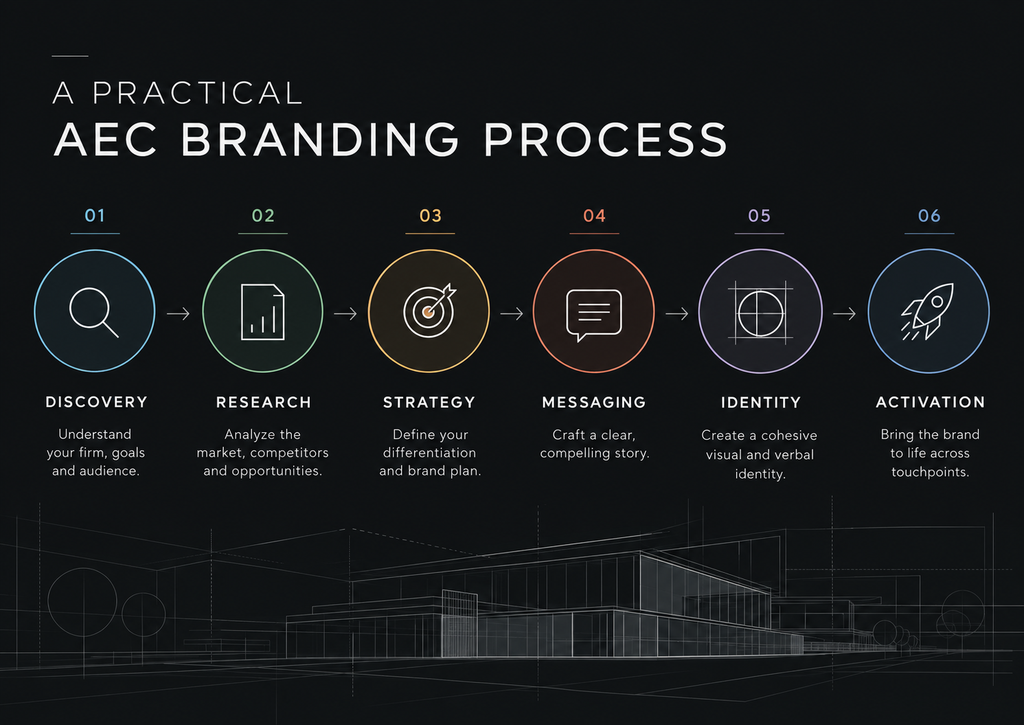
There is no single perfect methodology, but a serious branding process should move from evidence into strategy before creative execution begins.
1. Discovery
Understand leadership’s goals, history, ambitions, frustrations and assumptions.
2. Research
Interview employees, clients and other stakeholders.
Review the competitive landscape.
Look at market perception.
Understand how buyers actually evaluate the firm.
3. Strategy
Define audiences, positioning, differentiation and brand architecture.
Make strategic choices.
Not everything gets to be equally important.
4. Messaging
Develop the value proposition, messaging hierarchy, narrative strategy and proof.
5. Identity
Translate the strategy into a visual system.
6. Digital
Build the website architecture, user experience, SEO strategy and digital presence around how clients evaluate the firm.
7. Activation
Carry the strategy into proposals, presentations, campaigns, LinkedIn, social media, business development, recruitment and content.
8. Measurement
Connect activity to business outcomes.
How Should AEC Firms Measure Brand Strategy?
This is where marketing has to graduate from “we got a lot of likes.”
Reach matters.
Engagement can matter.
Website traffic matters.
But none of them automatically equals business impact.
A stronger measurement framework might look at:
Awareness inside priority accounts.
Direct and branded search growth.
Engagement from target organisations.
Organic visibility for priority expertise.
AI visibility for strategic queries.
Qualified website inquiries.
Marketing-sourced opportunities.
Marketing-influenced opportunities.
Proposal invitations.
Shortlist rate.
Win rate.
Pipeline value.
Repeat business.
Referral activity.
Recruitment quality.
Sales-cycle progression.
Then connect those signals inside the CRM wherever possible.
That is the difference between measuring marketing activity and measuring whether the market is actually changing.
Marketing should eventually influence revenue.
If the organisation cannot connect its digital marketing and brand activity to business development at all, the first issue may be measurement infrastructure rather than creative performance.
How Much Does AEC Branding Cost in Canada?
There is no responsible single number.
A small positioning engagement and a multi-office brand transformation involving research, strategy, messaging, naming, identity, website development, photography, video and proposal systems are entirely different projects.
Cost can vary based on:
The number of stakeholder groups.
Research depth.
Client interviews.
Brand architecture.
Naming requirements.
Strategy.
Messaging.
Visual identity.
Photography.
Website complexity.
SEO.
Video.
Templates and collateral.
Number of offices.
Launch support.
The useful question is not “What does branding cost?”
It is:
What problem are we trying to solve, and what scope is actually required to solve it?
How to Choose an AEC Branding Agency
Built-world experience matters.
Not because an agency needs to know every technical detail of every discipline.
It matters because AEC firms operate in a specific commercial environment.
Ask whether the agency understands:
How professional-services buyers evaluate firms.
How RFPs and proposals work.
How technical expertise affects trust.
How projects need to become stories.
How principals participate in business development.
How portfolios function as proof.
How specification and procurement affect manufacturers.
How digital visibility connects to relationships.
Then look beyond category familiarity.
Can they conduct research?
Can they challenge the firm’s assumptions?
Can they articulate positioning?
Can they translate strategy into messaging?
Can they build a useful digital system?
Can they show real case studies?
Can they explain the business problem behind the creative work?
A beautiful portfolio proves creativity.
It does not automatically prove strategy.
AEC Branding Examples: Show the Decision, Not Just the Deliverable
This section should eventually contain real work.
Not hypothetical companies.
For each example, document:
Client challenge
What business or perception problem existed?
Research insight
What did the team discover?
Positioning decision
What did the firm decide it wanted to own?
Brand strategy
How was that decision structured?
Creative execution
How did the strategy influence identity, website, content or collateral?
Business outcome
What changed?
Include actual screenshots.
Actual project material.
Actual quotes.
Actual metrics where they exist.
One detailed example with evidence is worth more than ten vague “branding inspiration” screenshots.
For these examples, pull from our case studies that just launched:
- https://spacesuncovered.com/case-studies/narp/
- https://spacesuncovered.com/case-studies/matra/
- https://spacesuncovered.com/case-studies/hudson-sales/
- https://spacesuncovered.com/case-studies/kel/
The Real Opportunity: Give Great Work a Voice

I learned this lesson through a project of my own.
JJ Bean at UBC.
I had helped design something real. Something I cared about. Something shaped by decisions, constraints, people and an enormous amount of thinking that nobody walking through the finished space would ever fully see.
And that is the problem.
Great work can disappear in plain sight.
The finished project exists.
The portfolio image gets uploaded.
The team moves onto the next deadline.
And the story behind the work vanishes.
Here are some final words from Alexa:
I was a senior interior designer at DIALOG, partnering with the architecture department to design the newest JJ Bean cafe and the first JJ Bean cafe to be located on a university campus, at UBC. As I was looking at a campus, the concept for the design needed to relate to the university life of a student. When students attend university, they are testing and trying many courses and many networking groups, meandering through their university journey with some level of confusion until they hopefully graduate and gain a sense of alignment around what they want as a career.To reflect a student journey, we designed the cafe to have a floor plan that forced visitors to JJ Bean to meander around large structures and obstacles within the cafe, allowing them to bump into and intersect with different types of seating arrangements and, in turn, meet different types of groups of people using the cafe space.
To reflect the sense of alignment achieved upon graduation, we invested in a custom light fixture that would be suspended in the centre of the cafe within the two-storey loft space.When people stand at the cashier at JJ Bean and look directly up, the way the extrusions of the light fixture align causes them to spell out “UBC.” Then, when people go to the second floor, sit at the bar-height seating, and look directly at the light fixture, the way the extrusions align spells out “JJB.”It was fascinating to tell this story and sell the client on the concept behind the light fixture, which tied into the overall design of JJ Bean, as it was cool for users of the space to decode the message.
The failure in all of this was that, after occupancy, the story behind the light did not live on. Not only did we not capture any photos of these extrusions in alignment, but we also did not put up a sign or create any marketing assets around the story.
To me, this was a failure that ended at occupancy and did not justify the investment spent on this custom light fixture design.This is an example of what happens often in the built world for contractors, designers, engineers, and architects, as they do not have time to tell the story of their designs. Yet that is how you showcase value and elevate the roles of those behind the project.
That’s why Spaces Uncovered’s mission is to give great work a voice. Buildings can’t speak, but we want Spaces Uncovered to be the platform that allows great work to be seen.
How many extraordinary firms in the built world are doing meaningful work that nobody outside the project team truly understands?
Probably far too many.
That is why brand matters.
That is why project storytelling matters.
That is why visible expertise matters.
And that is why the Invisible Shortlist matters.
Because great work does not automatically create visibility.
It does not automatically create credibility outside the people who already know you.
It does not automatically build your next opportunity.
You have to give the work a voice.
Frequently Asked Questions About AEC Branding Strategy
What are effective strategies for building a strong brand in the AEC industry?
Begin with research and positioning.
Then create the system that carries that position into the market.
That may include strong project case studies, visible technical experts, founder-led content, useful articles, LinkedIn, speaking, webinars, podcasts, video, email marketing, PR, SEO, strategic partnerships and thoughtful business development.
The exact mix will differ by firm.
The principle does not.
Do not start by asking what content you should post.
Start by asking what you want the market to remember.
Then make that truth impossible to miss.
How can AEC firms effectively measure the success of their brand strategy?
Start by connecting brand measurement to the firm’s actual strategic objectives.
That can include branded search, organic visibility, engagement from target accounts, direct traffic, qualified inquiries, proposal invitations, shortlist rates, win rates, recruitment metrics, pipeline influence and revenue.
Use CRM data where possible.
Likes and impressions can help diagnose distribution, but they are rarely the final business outcome.
What are key elements of an effective AEC brand strategy?
The foundations typically include a clearly defined audience, buyer research, competitive understanding, defensible differentiation, positioning, messaging, proof and a plan for bringing that strategy into the market.
The visual identity should express those decisions rather than substitute for them.
The best strategies also connect directly to commercial priorities. If the firm wants to expand into healthcare, enter a new region or attract larger development clients, the brand strategy needs to help make that future believable.
How can an effective brand strategy benefit AEC firms?
An effective strategy can make a firm easier to understand, remember and recommend.
It can clarify marketing priorities, improve proposal consistency, guide content creation, strengthen brand awareness, support recruitment and give business-development teams better language for explaining why the firm should be considered.
The greatest benefit is alignment.
Instead of dozens of disconnected marketing activities, the organisation begins reinforcing the same strategic position.
How do in-person events fit alongside digital marketing?
They reinforce each other.
A conference can create the relationship. The website validates it later.
A LinkedIn post can make a principal familiar before someone meets them at an event.
A webinar can deepen a conversation that started at a breakfast.
A podcast can give a prospective client an hour with your thinking before they ever speak with you.
Do not treat physical and digital marketing as competing worlds.
The buyer experiences one brand.
What Are Common Marketing Challenges in the AEC Industry?
visibility, proposals, content and the experience clients have with the organisation.
At its best, branding makes expertise easier to understand.
Common challenges include weak differentiation, generic messaging, overreliance on referrals, inconsistent content, poor project storytelling, limited leadership visibility and difficulty connecting marketing to business development.
AEC firms also tend to possess far more expertise than they publish.
That creates an unusual problem: the organisation already has the raw material for strong thought leadership, case studies and content marketing, but there is rarely a system for extracting it from busy technical teams.
What is AEC branding… really?
AEC branding is the process of shaping how architecture, engineering and construction firms are understood and remembered.
It includes positioning, messaging, visual identity, reputation, digital presence, project storytelling, expert opinions.
Why is Brand SEO Important?
Brand SEO helps control what buyers discover when they actively investigate your organisation, leadership and expertise.
Someone who hears about your firm through a referral may search the company name, principals, projects, reviews or specializations before contacting you. A strong search presence makes it easier for that buyer to validate what they have heard.
It also supports broader discoverability. Search engine optimization can help individual areas of expertise become visible before somebody knows the firm’s name.
Is there any instance in which it might be advantageous for an A/E/C firm to take a generalist approach?
Yes.
A generalist model can make sense when clients genuinely value a broad range of integrated capabilities, particularly when the firm can coordinate those services effectively or serves a market where convenience and continuity matter.
But “generalist” should not mean “we have no point of view.”
A multidisciplinary firm can still be known for a specific type of client, project complexity, geographic knowledge, delivery model or way of working. Breadth describes capabilities. Positioning explains why the breadth matters.
How Do You Stand Out in an Overcrowded AEC Market?
Start by resisting the urge to sound impressive.
Instead, become specific.
Define which clients you are best equipped to serve, which problems you solve particularly well, what expertise supports that claim and what evidence proves it.
The strongest AEC brands rarely differentiate through louder language. They differentiate through a clearer combination of specialization, point of view, people, process and proof.
Then visibility has to follow. Strong positioning nobody encounters is still invisible.