
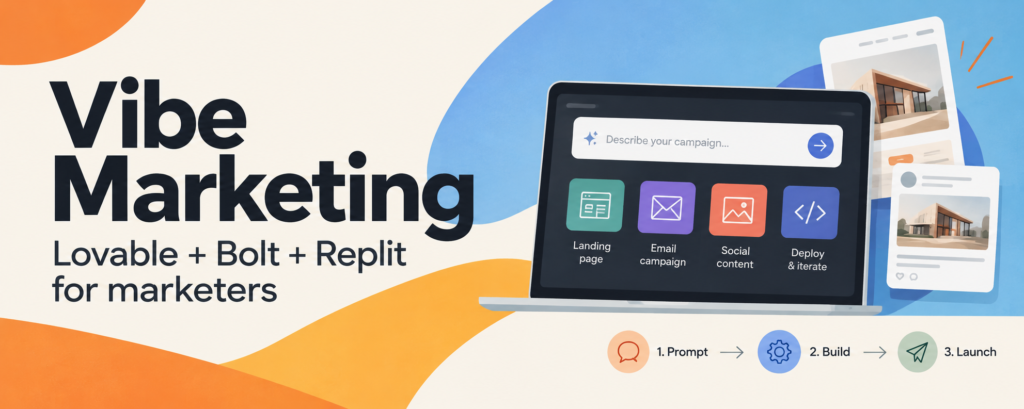
AI is making marketing faster, more accessible, and easier to produce than ever. A campaign that once moved through multiple teams can now take shape with a handful of tools and the right instructions.That’s genuinely exciting.
I use AI in my own work, and I think we’re only beginning to understand what it makes possible.
But there’s a question we aren’t asking enough.
Just because you can create the marketing, does that mean you know what the marketing needs to accomplish?
For architecture, design, construction, real estate development, and building product companies, that distinction is especially important. Buying decisions are rarely made because somebody saw a clever LinkedIn post. They are shaped by technical credibility, reputation, relationships, perceived risk, and whether a company understands the people it wants to reach.
AI can help bring a campaign to market faster.
It can also help you tell the wrong story to the wrong audience at extraordinary speed.
The future of marketing isn’t a competition over who can produce the most content. It’s about who understands the business well enough to create something worth paying attention to.
And that is where the conversation about vibe marketing gets interesting.
What Is Vibe Marketing?

The simplest definition is this:
Vibe marketing is using AI to move from marketing intent to marketing execution with far less manual work between the two.
Instead of manually completing every stage of a campaign, marketers can increasingly provide an AI system with context about their business, audience, positioning, objectives, and creative direction.
AI can then assist with research, develop concepts, draft content, prototype websites, create advertising variations, connect workflows, and analyze results.
The marketer increasingly directs parts of the system rather than physically producing every component.
That is where the word vibe comes in.
Not because the work should be based on feelings.
And definitely not because strategy has disappeared.
The “vibe” is closer to intent.
You know where the work needs to go. You understand the customer. You recognize when something feels off. You can evaluate whether the result fits the brand, whether the idea has teeth, and whether it actually solves the problem.
AI handles more of the execution between those decisions.
That is the promise.
The danger is believing the machine knows which story deserves to be told.
Why Vibe Marketing Is Happening Now
Vibe marketing evolved from the idea of vibe coding, a term popularized in 2025 to describe using natural-language instructions to direct AI systems to develop software.
The underlying shift is significant.
Natural language is becoming an interface for doing the work.
Technologies that previously operated separately are beginning to work together. Large language models can synthesize information and develop ideas. Generative tools can create images, video, text, and code. Automation platforms can connect activities across software. AI agents can increasingly handle multi-step processes with varying degrees of autonomy.
Platforms such as ChatGPT, HubSpot, Zapier, and emerging AI development tools are making sophisticated workflows more accessible.
Individually, these technologies are useful.
Together, they change what a marketing team can accomplish.
A company can move from a customer insight to a campaign concept, prototype, and initial test with fewer manual steps than before.
That changes the economics of marketing production.
But it doesn’t automatically improve the economics of acquiring customers.
Those are two very different outcomes.
The Good: What AI Actually Makes Better
There is a lot to like about vibe marketing.
I’m not interested in pretending that traditional marketing workflows were always efficient or that every activity required a specialist to do it manually.
Some processes were slow simply because the tools were slow.
Others involved too many handoffs, repetitive administration, unnecessary approvals, or production tasks that consumed time better spent elsewhere.
AI creates legitimate opportunities to change that.
More room to experiment
One of the most interesting advantages is how much easier it becomes to explore ideas.
A team might develop several campaign concepts, compare different headlines, prototype landing pages, or explore new approaches to communicating an existing offer.
That doesn’t make every concept good.
It gives the team more possibilities to evaluate before committing production resources.
The value isn’t generating fifty headlines.
It’s discovering which of those headlines communicates something meaningful to the customer.
Where AI helps me in my own work

I use AI in my own work at Spaces Uncovered, particularly when I need to turn a lot of unstructured thinking into something another person can follow.
A presentation might begin with messy notes from conversations and audio recordings captured through Wispr Flow. I use AI to help sort those thoughts into themes and a structured list of potential slides. Then I use other AI-assisted tools to add context, explore how the information might flow, and generate an initial visual wireframe.
That gets me past the blank page much faster.
But it is not the finished presentation. AI slide builders can suggest layouts and structures, but they don’t reliably deliver the level of design refinement or brand alignment I want for Spaces Uncovered or our clients. I still rebuild the final deck using the AI version as a starting point, not as the final authority.
The important decisions remain mine: which ideas belong, which ones need to go, what the audience should understand first, and how the story should look and feel.
That’s the part of AI-assisted work I find most useful. It can accelerate exploration without replacing the judgment that makes the final work effective.
Smaller teams can accomplish more
A small marketing team can use AI to help organize research, create early drafts, repurpose existing material, summarize performance data, and automate repetitive work.
That is a genuine advantage.
A company shouldn’t need an external agency every time it wants to rewrite a routine email, prepare a preliminary outline, or summarize a meeting.
But producing a deliverable and knowing whether it is strategically effective require different capabilities.
The expertise a team needs depends on what it is trying to accomplish, how well it understands its market, and the consequences of getting the decision wrong.
Faster access to company expertise

This is particularly interesting for architecture, engineering, and construction.
Think about how much knowledge exists inside a typical firm.
The principal who understands why a project succeeded.
The architect who navigated a complicated municipal approval.
The construction manager who resolved a problem that threatened the schedule.
The manufacturer’s technical representative who knows exactly why a product gets rejected during specification.
These people have valuable knowledge.
They often don’t have time to translate that knowledge into marketing materials.
AI can help organize interviews, identify themes, structure content, and adapt approved ideas for different audiences and channels.
The technology helps the expertise travel.
That is a much more interesting opportunity than simply producing more social media posts.
Better feedback loops
AI can also help teams analyze campaign performance, identify emerging customer questions, and compare results across different marketing activities.
This can shorten the distance between learning something about a customer and responding to it.
But the goal should be learning faster, not just producing faster.
There’s a difference between discovering that a campaign generated more clicks and understanding whether it changed how a potential customer evaluates your company.
One is a metric.
The other is a marketing question.
The Bad: When Vibe Marketing Automates Mediocrity

This is where the concept gets butchered.
Someone types:
“Write me five LinkedIn posts for an architecture firm.”
GPT creates five posts.
They publish them.
Congratulations.
You have automated mediocrity.
That is not a meaningful marketing strategy.
The fastest way to make your brand indistinguishable from everybody else is to give everybody else the same model and approximately the same prompt.
AI-generated content tends toward familiar patterns when it has no original material to work from.
The cure is not a better adjective prompt.
It is better source material.
Experience. Research. Opinions. Data. Projects. Customer language. Original thinking.
And, perhaps more importantly, knowing which of those things actually matters to the people you’re trying to reach.
Your positioning problem becomes a production problem

Imagine an architecture firm that describes itself as innovative, collaborative, sustainable, and client-focused.
Now imagine its ten closest competitors saying exactly the same thing.
AI can help that firm produce fifty pieces of content around those four attributes.
It can develop articles about innovation, social posts about collaboration, and beautifully written statements about sustainability.
But the underlying positioning hasn’t changed.
The company is simply communicating an undifferentiated message more frequently.
That is not brand building.
That is scaling a problem that should have been solved before production began.
AI can amplify a strong brand strategy. It can also accelerate ineffective messaging when the underlying positioning is weak.
And the faster those messages travel, the more opportunities there are for the market to encounter something that doesn’t meaningfully distinguish your company.
Your brand voice quietly disappears
AI can approximate tone surprisingly well.
But a brand voice is not just sentence length and vocabulary.
It includes what you believe.
What you refuse to say.
What you notice.
How you frame problems.
What kind of evidence earns your trust.
A model can learn patterns from previous marketing materials. It can also help teams examine inconsistencies and explore new positioning directions.
But there is a difference between reproducing a recognizable style and establishing a point of view that customers have a reason to remember.
That requires understanding the business, its customers, and the competitive space it occupies.
Technical credibility becomes a real risk
This is especially dangerous in the built world.
Architecture. Engineering. Construction. Building products.
Codes. Specifications. Performance claims. Standards.
You cannot let an AI system confidently invent a technical fact because the sentence sounded good.
An inaccurate claim about a building product’s performance could undermine credibility, create unnecessary risk, or mislead someone making an important specification decision.
Human review is not optional when accuracy matters.
And that review must involve people qualified to validate the claims, not simply someone who can recognize good writing.
More attention doesn’t always mean better marketing
AI makes it incredibly easy to create content engineered around engagement.
That doesn’t mean engagement is the business objective.
You can build a very efficient machine for getting attention from people who will never buy from you.
That is still bad marketing.
For a building product manufacturer, a smaller number of qualified specification inquiries may matter far more than thousands of impressions from people outside the buying process.
For an architecture firm, being considered by the right developer may be more valuable than generating broad social engagement.
If you measure the wrong outcome, AI can help you optimize for it exceptionally well.
The Gap: Marketing Production Is Not Marketing Strategy
This is the part I care about most.
Because every new tool cycle creates the same temptation.
The tool becomes the strategy.
Social media arrives.
Everyone needs social.
SEO grows.
Everyone needs blogs.
Video grows.
Everyone needs video.
AI arrives.
Everyone needs AI.
No.
You need customers.
You need something worth buying.
You need positioning people can understand.
You need a reason to believe.
You need a compelling offer.
You need a brand people remember.
You need distribution.
You need measurement.
And you need to understand the humans making the decision.
AI can contribute to nearly every one of those activities. It can help analyze competitive positioning, interrogate assumptions, explore market opportunities, and develop strategic hypotheses.
That contribution can be valuable.
But generating a strategic recommendation is not the same as proving that the recommendation is correct.
The output still needs to be tested against actual customers, competitive realities, commercial priorities, and the experience of people who understand the industry.
Somewhere, someone must be accountable for choosing the direction.
Good marketing isn’t just about creating the right assets. It’s about identifying the right problem to solve.
That distinction is easy to overlook when production becomes so accessible.
The Real Competitive Advantage Is Knowing Which Problem to Solve

Let’s make this built-world specific.
At Spaces Uncovered, we worked with a distributor and supplier whose leadership believed its sales team had a good pulse on the market. The team had longstanding relationships with customers and partners, so there was reason to feel confident about its position.
But confidence inside a company and perception outside it aren’t necessarily the same thing.
We conducted a market perception survey among its existing partners and customers. What we learned challenged some of the company’s assumptions.
The distributor was less visible than it believed. Some respondents were familiar with one of its brands but not the broader portfolio. Its limited digital presence also meant it wasn’t always top of mind when opportunities arose.
From the inside, the team hadn’t necessarily seen those missed opportunities. From the outside, customers didn’t always understand the full breadth of what the distributor could offer.
A conventional response might have been to promote more products, publish more content, or try to appear bigger.
But the research pointed to a more interesting positioning opportunity.
The distributor’s select group of longstanding manufacturer partnerships wasn’t simply a limitation. It was part of what made the company valuable. Those relationships gave the team deep technical knowledge, historical product experience, and the ability to respond quickly when customers needed help.
The very thing that could be perceived as a narrow offering was also the foundation of a credible difference.
We used that insight to shift the message of the website and brand collateral away from the apparent limitation of its portfolio and toward the benefits customers actually needed: reliable manufacturer relationships, responsive support, practical technical expertise, and help solving problems on site.
That is not a claim that the repositioning automatically produced more revenue or leads. We would need performance evidence to make that claim. The result I can speak to is the strategic change: real customer research helped us identify a stronger, more defensible story to tell.
AI might have helped us summarize survey responses or explore messaging directions. But it could not substitute for asking the market, understanding what the answers meant in this industry, and recognizing an advantage the company had been underselling.
The most important marketing decision happened before another asset was produced.
It was deciding what the market needed to understand about the company in the first place.
Why This Matters More in Architecture, Design, and Construction

Marketing in the built world isn’t always a straightforward transaction.
Consider how an architecture firm wins a major project.
A developer may have encountered its work years earlier.
Another architect might recommend the firm.
A previous client might mention a successful project.
A consultant may already know its reputation.
By the time an RFP arrives, some firms may already be more familiar or credible than others.
The shortlist can begin forming before the formal procurement process.
That is why visibility alone isn’t enough.
A firm needs to influence how the market understands its expertise before someone is actively looking to hire it.
The same principle applies to building product manufacturers, general contractors, and other built-world businesses, although their buying journeys differ.
There may be technical gatekeepers.
Multiple decision-makers.
Long project timelines.
Procurement restrictions.
Professional relationships built over years.
And substantial consequences when a buyer chooses the wrong partner or product.
In that environment, marketing needs to do more than attract attention.
It needs to build confidence, establish relevance, communicate technical capability, and give decision-makers reasons to include a company in their consideration set.
That requires understanding who influences the decision, what objections exist, and what evidence those people need.
AI can help deliver the resulting message.
But somebody needs to understand the decision in the first place.
Taste Becomes More Valuable When Production Becomes Accessible

If everybody has access to GPT, everybody has access to GPT.
If everybody can generate fifty headlines before breakfast, generating fifty headlines is no longer particularly impressive.
If AI can reproduce elements of your brand voice, producing a piece of branded copy is no longer much of a competitive advantage on its own.
Production is becoming more accessible.
Judgment remains valuable.
Original experience remains valuable.
A real customer insight remains valuable.
A meaningful project story remains valuable.
An unusual opinion earned through twenty years of work remains valuable.
Taste remains valuable.
And taste isn’t simply knowing whether something looks beautiful.
In strategic marketing, it is recognizing whether the creative work communicates the right idea to the right people, whether it feels credible for the brand, and whether it serves a commercial purpose.
Professional creative direction matters because there is a difference between an attractive asset and an effective one.
For the built world, the raw material for distinctive creative work is often already there.
The difficult detail nobody photographed.
The conversation that changed the project.
The material decision that saved weeks later.
The coordination problem the team quietly solved.
The client concern nobody anticipated.
The superintendent who knew exactly what would go wrong before it did.
AI can help package those stories.
It cannot have lived them.
And without someone recognizing why those stories matter, they may never become part of the brand’s narrative.
This Is Why Story Matters More in an AI-Saturated Market
AI creates an interesting contradiction.
Technology makes content creation easier.
Which means content itself becomes less scarce.
What becomes more valuable?
The things the model cannot truthfully fabricate.
Firsthand experience.
A distinctive point of view.
Real research.
Original data.
Actual projects.
Unexpected decisions.
Credible expertise.
The truth behind the work.
This is where brand storytelling becomes more important, not less.
Think about an architecture firm’s project portfolio.
The website may show a beautiful collection of completed buildings.
But the photographs don’t necessarily explain why the firm was chosen, what it understood about the client’s needs, or what decisions made the project successful.
Those details can be far more persuasive than another gallery of finished spaces.
A strong project narrative connects the work to something meaningful.
What was the challenge?
Why did it matter?
What was at stake?
What was the firm’s contribution?
And what changed because of it?
That story can become a case study, a video, a presentation, an article, a sales asset, or a series of communications adapted to different audiences.
AI can help organize and extend that material.
But the underlying story still has to be discovered, developed, verified, and creatively directed.
The strongest marketing doesn’t manufacture expertise.
It makes real expertise visible.
What Human Judgment Looks Like During a Real AI-Assisted Campaign
This isn’t just a question of high-level brand strategy. Human involvement can change the quality of the work at every stage of a campaign.
Spaces Uncovered partnered with Mirage Floors on a three-month campaign for a new flooring collection. The work included filmed content with the company’s sales representative, outreach through email and LinkedIn, a regional landing page, scripts for featured design partners, and a content calendar connecting the different pieces.
We used AI at different points throughout the campaign, including for initial video scripts and a preliminary social media calendar.
But a first draft is not the same as a credible finished asset.
I brought my knowledge of the design and building-products audience to the scripts, refining the language to reflect what would resonate with the people Mirage wanted to reach. On site, I also worked directly with the sales representative as we filmed. The script was a guide, not something he had to repeat word for word. Part of my role was helping him feel comfortable and communicate in his own voice so the finished video felt like him, rather than a person reading AI-generated copy off a teleprompter.
The content calendar required the same attention to detail. AI could give us a useful starting structure, but it didn’t know every designer, industry collaborator, venue, project name, or trade that needed recognition in the stories we were publishing. Those details required hands-on curation and knowledge of the relationships behind the work.
We also needed to organize the calendar so Mirage’s team could review it, give feedback, and approve materials before publication. The process had to support collaboration, not simply generate posts.
None of this means AI is incapable of helping with coordination or approval workflows. It means that, for this campaign, the quality and credibility of the finished work depended on people who understood the brand, the industry, the individuals on camera, and the relationships behind the projects.
AI helped us move faster. It did not direct the people on set, verify the context of the stories, or make the final creative decisions for us.
Visual Storytelling Still Needs a Story
Generative tools make visual production increasingly accessible.
That does not automatically create visual storytelling.
A beautiful AI image with no relationship to the truth behind the project is decoration.
The same applies to cinematic storytelling.
Drone footage is not automatically a story.
Slow-motion concrete pours are not automatically a story.
A designer staring intensely at a material sample while moody music plays is definitely not automatically a story.
Sorry.
The strongest storytelling in architecture usually comes from intention.
Why was this decision made?
Who was the space for?
What constraint shaped it?
How did the occupants respond?
What almost went wrong?
What did the finished photograph hide?
Those questions create material people can remember.
Professional photography, film, design, and writing can bring those stories to life in ways that respect the work and influence how the audience perceives it.
AI can assist creative professionals with exploration and production.
It doesn’t make their expertise irrelevant.
If anything, the availability of more visual content raises the importance of developing something distinctive and purposeful.
The goal isn’t simply to make more things that look good.
It’s to help people see what makes the work worth choosing.
AI Can Make Marketing More Efficient. That Doesn’t Make Marketing More Valuable by Default.
This is an important distinction for both agencies and their clients.
The cost of producing an asset and the commercial value of that asset are not the same thing.
Imagine two campaigns.
The first is produced quickly using AI. It looks professional, follows brand guidelines, and generates a reasonable amount of engagement.
The second takes more time to develop because the team interviews customers, investigates competitive positioning, identifies a specific objection in the buying process, and develops a campaign around it.
That second campaign may also use AI extensively.
In fact, AI might make its production significantly more efficient.
The difference isn’t whether one campaign uses technology.
It’s whether the strategy behind it creates a stronger reason for the right customer to act.
A campaign that costs less to produce is only a better investment if it achieves the required outcome at an appropriate cost and level of risk.
Sometimes a simple internal AI workflow is exactly what a business needs.
Sometimes a problem requires deeper research, repositioning, creative development, or specialized industry knowledge.
The decision should depend on the value and complexity of the problem, not on an assumption that everything needs an agency or that everything can be solved with a prompt.
What Should Businesses Keep In-House, and When Does External Expertise Make Sense?
Not every marketing task requires an agency.
Businesses can successfully use AI for routine content adaptation, preliminary research, administrative automation, reporting summaries, internal brainstorming, and early creative exploration.
Teams with strong marketing leadership, reliable customer research, appropriate technical oversight, and clear brand direction may be able to manage much more internally.
That is a good thing.
But there are moments when an outside perspective creates a different kind of value.
When your company struggles to explain how it differs from competitors.
When your marketing attracts attention but not qualified opportunities.
When different audiences need different reasons to trust the same brand.
When a new market, service, or product requires a positioning decision.
When your sales team understands customer objections that never appear in your marketing.
When the company has extraordinary projects and expertise but no compelling way to communicate them.
Or when your team is producing more content than ever and you’re still not sure whether it’s influencing the right buying decisions.
Those aren’t necessarily production problems.
They’re questions about research, positioning, brand development, storytelling, commercial strategy, and performance.
An external strategic partner can bring industry perspective, challenge internal assumptions, identify patterns across the market, and connect those insights to the work that follows.
The point isn’t to outsource thinking.
It’s to make sure the right thinking happens, wherever the expertise sits.
How to Use Vibe Marketing Without Losing Your Brand
Please do not begin by purchasing eighteen subscriptions.
Start with a real business objective.
Not “experiment with AI.”
Not “post more consistently.”
And definitely not “our competitor is using agents, so we need agents.”
Ask what needs to change.
Do you need to attract a different type of client?
Increase specification consideration?
Improve your position in a market?
Help developers understand a capability they currently overlook?
Turn existing relationships into more opportunities?
Then look at the evidence.
What do you know about the audience?
What assumptions are you making?
What are competitors claiming?
What does your sales team hear?
What can your projects, customers, and technical experts actually substantiate?
Only then should the production conversation begin.
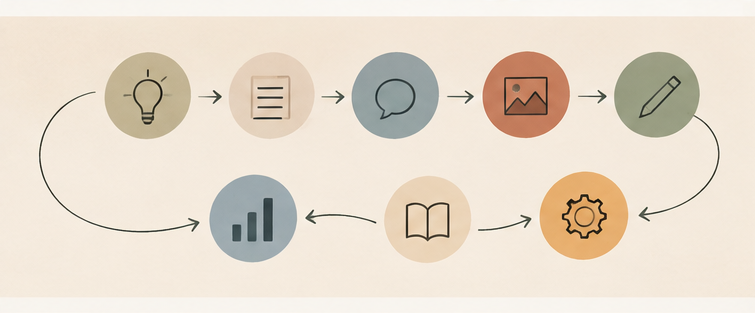
A useful AI-assisted marketing system follows a loop:
Insight → Hypothesis → Strategic direction → AI-assisted creation → Expert review → Launch → Customer response → Learning
The tools can accelerate multiple stages.
But the decisions still need appropriate oversight.
For some campaigns, that might mean marketing leadership. For others, it might involve a technical expert, creative director, sales leader, client stakeholder, or outside specialist.
The goal is not to create unnecessary approvals.
It’s to make sure faster execution doesn’t come at the expense of the decisions that matter.
Measure customer response, not AI productivity
Nobody cares how quickly your marketing team generated the campaign.
Customers certainly don’t.
Depending on the objective, meaningful measures might include qualified inquiries, meetings with target accounts, specification requests, inclusion in consideration sets, proposal opportunities, conversion rates, pipeline quality, or revenue.
Not every brand-building activity can be directly attributed to a sale, especially in industries with long buying cycles.
But that doesn’t mean its impact should be ignored.
A credible measurement approach considers both earlier indicators, such as recognition and engagement among priority audiences, and downstream evidence of commercial progress.
The point is to learn whether marketing is influencing the right people.
Because the customer gets the final vote.
How Vibe Marketing Can Strengthen Brand Perception

Used well, AI-assisted marketing can help a brand become more present, useful, and consistent.
A company can respond to emerging questions faster.
Experts can publish more consistently.
Great ideas can travel across more formats.
Customer questions can become useful content before six months of internal approvals destroy their relevance.
Brand storytelling can show up throughout the customer journey instead of living inside one brand film nobody watched.
But there is an important caveat.
More content does not automatically mean stronger brand perception.
Consistency without distinctiveness simply makes you forgettable more consistently.
A strong brand needs recognizable ideas.
A clear point of view.
Credible evidence.
A meaningful position in the market.
AI should amplify those things.
Not manufacture a substitute.
Where Vibe Marketing Goes Next
Here is my prediction.
We will probably stop talking about vibe marketing eventually.
Not because the idea failed.
Because much of it will simply become marketing.
Marketers will expect software to understand natural-language instructions.
Campaign platforms will incorporate more AI-assisted execution and agents.
Data analysis will increasingly begin with questions rather than dashboards.
Content workflows will become more connected across text, video, imagery, and digital experiences.
And repetitive production tasks will continue to change.
That is the technology story.
The more interesting story is what happens to the value of marketing expertise.
As production becomes more accessible, it becomes easier for companies to communicate.
But it doesn’t automatically become easier to differentiate themselves.
More companies can publish.
More companies can advertise.
More companies can generate professional-looking creative.
And their competitors can do the same.
The result may be an increasingly crowded market filled with more content that looks and sounds remarkably similar.
In that environment, the important questions move upstream.
What do we want to be known for?
Who are we actually trying to influence?
What does our market believe about us today?
What should it believe instead?
What evidence will change that perception?
And how does that perception translate into business opportunity?
Those are the questions that shape meaningful marketing.
The technology changes how we execute the answers.
The Work Is Faster. The Truth Still Takes Time.
There is a version of the vibe marketing conversation that gets very excited about one person doing the work of ten.
Maybe.
Sometimes.
But I think that framing misses the most interesting part.
The cost of execution is dropping.
That exposes everything underneath it.
Weak positioning becomes easier to publish.
Generic thinking becomes easier to distribute.
A forgettable brand can now be forgettable across twelve channels simultaneously.
Efficient.
But still forgettable.
The opportunity is different.
Use the machine to remove friction around great thinking.
Take the conversation trapped inside a project team and give it somewhere to go.
Take a technical expert who has never had time to write and help them share what they know.
Take the hidden story behind the building and turn it into something the market can understand.
Take one meaningful idea and give it more ways to travel.
That’s the version of vibe marketing I care about.
Not AI replacing the storyteller.
AI giving great work a louder voice.
And the implications go beyond storytelling.
The easier it becomes to produce marketing, the more important it becomes to know what deserves to be produced.
Businesses should expect their marketing partners to embrace AI, eliminate unnecessary inefficiencies, and use emerging technology intelligently.
But they should also expect something much more valuable.
A deep understanding of their industry.
The ability to uncover what actually differentiates their business.
The judgment to develop a compelling position in the market.
The creative expertise to make that position memorable.
And the commercial understanding to connect it to meaningful opportunities.
Because the most important question was never, “How quickly can you make my marketing?”
It’s, “Do you understand my business well enough to make my marketing matter?”
A Different Conversation About Marketing
At Spaces Uncovered, we’re interested in how strategy, storytelling, creative execution, and emerging technology work together to help built-world businesses stand out.
If your team is creating more marketing than ever but struggling to explain what makes your company different, that’s a more interesting conversation than which AI tool you should use next.
Let’s explore what your market needs to understand about your business before you create another campaign.
Frequently Asked Questions About Vibe Marketing
What is vibe marketing?
Vibe marketing is an AI-assisted approach to marketing where people define objectives, provide business context, guide creative direction, and use AI tools to help execute activities such as research, content development, campaign creation, automation, and analysis.
It can reduce production friction, but it doesn’t remove the need for strategy, expertise, or accountability.
Does vibe marketing replace marketing agencies?
Vibe marketing can reduce the need to outsource certain routine production tasks. Businesses with strong internal capabilities may successfully use AI for drafting, repurposing, preliminary analysis, and some campaign execution.
However, agencies can still add significant value through customer research, competitive positioning, brand strategy, creative direction, specialist expertise, and commercial accountability.
The right decision depends on the problem the company is trying to solve.
What are the main advantages of vibe marketing?
The main advantages include faster experimentation, more efficient production, easier content adaptation, improved workflow automation, and shorter feedback loops.
The greatest opportunity is using these efficiencies to test better ideas and improve marketing performance rather than simply increase content volume.
What are the disadvantages and risks?
Potential risks include generic messaging, inaccurate technical claims, inconsistent branding, data privacy problems, weak quality control, ineffective automation, and optimizing for superficial engagement rather than business outcomes.
Businesses can also unintentionally scale ineffective positioning by using AI to distribute undifferentiated messaging.
Can AI create a brand strategy?
AI can contribute meaningfully to brand strategy by analyzing research, exploring competitive positions, generating hypotheses, and identifying potential messaging directions.
However, its recommendations still require reliable market evidence, informed interpretation, validation, and decisions by people accountable for the business outcome.
An AI-generated positioning statement is not proof that the position is differentiated, credible, or commercially effective.
How can architecture and construction companies use vibe marketing?
Architecture, engineering, construction, and building product companies can use AI to organize expert interviews, develop project stories, assist with technical content, repurpose approved material, explore campaign ideas, and improve marketing operations.
Because these industries involve technical requirements, professional relationships, and complex buying decisions, content should be grounded in verified expertise and an understanding of the purchasing process.
How should businesses measure the success of vibe marketing?
Success should be measured against the original business objective, not simply the speed or quantity of AI-generated work.
Relevant measures might include qualified leads, specification inquiries, target-account engagement, sales opportunities, customer understanding, conversion rates, and longer-term revenue contribution.
Is vibe marketing right for every business?
Not every workflow benefits equally from AI or automation.
Routine tasks, early-stage ideation, and content adaptation may be strong candidates. High-stakes technical communications, sensitive information, significant positioning decisions, and major creative investments typically require more rigorous review and specialist involvement.
The objective is to use AI where it adds value, not introduce it into every activity for its own sake.
What is the difference between vibe marketing and traditional marketing?
Traditional marketing and vibe marketing share the same commercial fundamentals: understanding customers, establishing positioning, developing creative work, distributing messages, and measuring results.
Vibe marketing changes how portions of that work are performed, often using AI to reduce manual tasks and shorten execution cycles.
It does not change the underlying requirement to persuade the right customer for the right reason.
Why does brand strategy matter more as AI marketing grows?
As AI makes professional-looking content easier to produce, access to production tools becomes less of a differentiator.
Companies still need to establish a credible position, communicate a meaningful difference, and earn attention and trust.
Strong brand strategy gives AI-assisted marketing something distinctive to amplify. Weak strategy simply becomes easier to distribute.